
Slavery and St. Luke's Church
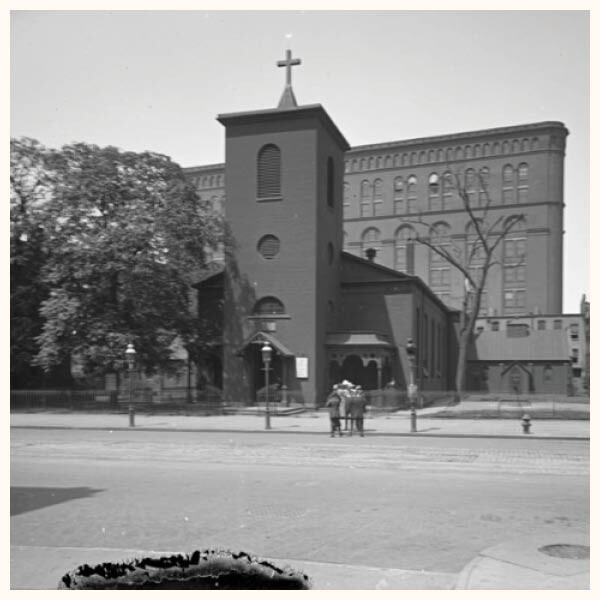
The following is an excerpt of an essay written by Bruce Goerich, edited by Andrew Forell, Archivist. To see the full essay, please contact Andrew Forell.
AN OVERVIEW OF THE EPISCOPAL CHURCH AND SLAVERY
The Episcopal Church has a long and complex history with enslavement. At the official level, the issue was seen in legal and political rather than moral and ethical terms. In this the Church followed the wider social mores of the day. In 19th century New York, slavery was entwined with the economic health of the city. Although there were African-American Episcopal congregations, they were denied official representation at Diocesan Conventions. The Church remained largely silent on the rollback of Black rights in the aftermath of the Civil War partly to avoid a schism between the Northern and Southern chapters. It’s worth noting the exodus of black congregants from the Church during the Reconstruction period and the fact that the Church was and remains overwhelmingly Caucasian in make-up.
SAINT LUKE IN THE FIELDS EARLY YEARS
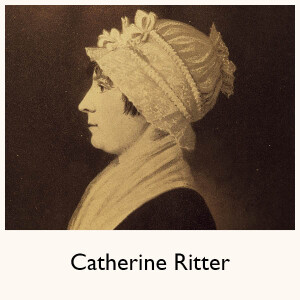 The foundation of the congregation of Saint Luke in the Fields was led by Catherine Ritter and her son-in-law Don Alonso Cushman in 1820. The original church building was constructed between 1821 and 1822. Richard Kidney, the contractor, was of English/Irish descent, and lived in the area. Many of the men who built the Church were taken from the pool of local workers - and it's interesting to note at the time the Stone Masons union was powerful enough to prevent the use of non-union labor. Although there is no information about the composition of the labor force, the workers were probably paid quite well - the church building costs were not inconsiderable for the time, and labor would have taken up a goodly part of the outlay.
As early as 1828, when the congregation consisted of about 100 families, St Luke's installed 18 new pews of which, according to the Vestry minutes: "The two back pews next to the wall on both sides of the Church are hereby appropriated to the use of the People of Colour [sic} attending this Church”1. In 1837 A.B McDonald, the Sunday School Superintendent, had the Vestry reserve space for the children on both sides of the organ. Two pews in the North Gallery were also reserved for African American worshippers. Although segregated within the Church, they were not excluded.
Clement Clarke Moore, Saint Luke's first Warden and longtime benefactor of the Church, certainly owned slaves and was a vocal opponent of abolitionism. Don Alonso Cushman was also aligned with anti-abolitionist, pro-slavery factions.
THE DRAFT RIOTS
During the Draft Riots of 1863, tensions among a lowly paid Irish and German workforce exploded into anger that freed slaves would take their jobs, compounded by a stricter draft law for the Civil War that excluded African Americans (they were not considered citizens). At the time, Little Africa – the area between Bleecker and McDougall - contained a quarter of the City's African American population. During the riots, two Black men were lynched just a block from the Church, and when the mob threatened to overrun Hudson Street and burn down PS32,St Luke's gave the African American janitor and his family sanctuary.3
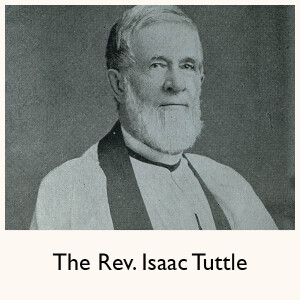 The rector of the time, Isaac Tuttle, was the motivating social conscience of St Luke's and initiated many of the Church's social programs. He was also instrumental in removing Pew Rents and realized his goal of making St Luke's a free church.
THE 1860 DIOCESAN CONVENTION
At the 1860 Episcopal Diocese of New York convention, John Jay, the grandson of the anti-slavery Supreme Court justice, put a resolution before the convention urging them to condemn Slavery. Jay spoke twice, laying out the history of the Church’s attitudes to slavery that highlighted the schism between the Northern and Southern branches of the Church and that with the English Church, which had long condemned the practice of slavery. He urged the Bishop to write a Pastoral Letter and Clergy to preach on the subject. He concluded with:
"Therefore Resolved, That this Convention, in order to prevent all misapprehension in regard to the position of the Church in this Diocese on the subject of the Slave Trade, do hereby declare and announce, that the Convention do utterly reject the doctrine that men may be lawfully kidnapped and held in slavery by any other person, and do utterly condemn the said practice as a great sin against God and man; and do adopt, in regard thereto, the words of St Cyprian, in writing to the Bishop of Numidia: "Both religion and humanity make it a duty for us to work for the deliverance of the captive, . . . It is Jesus Christ, himself, of whom we ought to consider in our captive brothers. It is Him whom we should deliver from captivity--Him, who hath delivered us from death.”4
A motion was made to table the resolution. Jay’s resolution was tabled (effectively killing it) by a clergy vote of 55 to 7 and a laity vote of 44 to 6. Of those from St. Luke's, Rev. Tuttle joined the majority of delegates in abstaining. However, the three lay delegates (all vestry members), A. B. McDonald, James Wallace, and Francis Pott, voted to table the motion.
Finally, the individual who proposed tabling Mr. Jay’s second motion was Mr. Floyd Smith, a delegate from the Church of the Annunciation, New York, another son-in-law of Catherine Ritter and former vestryman and warden at St. Luke’s. The rector of the Church of the Annunciation was then the Rev. Samuel Seabury, who had himself written a book, American Slavery … Justified by The Law of Nature.5
FINAL NOTES
Unfortunately, the full scope of any Saint Luke's parishioners' direct or indirect involvement in the business of slavery cannot be fully discerned; the parish records are largely quiet on these issues and the early census household membership and occupation data are not forthcoming on detail.
At most, the involvement of some congregants in banking, shipping and commerce could lead one to conclude that, like many of the social and economic leaders of New York at the time, they had at least a passive acceptance of the status quo if not active benefit therefrom. Any individual or personal sympathies, Don Alonso Cushman withstanding, cannot be ascertained at this time with the resources available.
1 Mrs. H. Croswell Tuttle, History of St Luke’s Church in the City of New York, 1820 -1920, Appeal Printing Company, 1926, p 25
2 The original (1818) PS3 was housed in a room in the police station on the corner of Hudson & Christopher. It was then moved to its present site in a wooden building in 1820 which was replaced by a brick building in 1860. That building was destroyed by a fire in 1905 and rebuilt. From 1820 to 1860 it was known as Grammar School 3 then reverted to PS3. The present version, The Charrette School, was founded in 1971.
3 Mrs. H. Croswell Tuttle, History of St Luke’s Church in the City of New York, 1820 -1920, Appeal Printing Company, 1926, pg 135
4 "Journal of the Proceedings of the 77th Convention of the Protestant Episcopal Church in the Diocese of New York" September 26 1860, published by Daniel Dana 1860, pg 87
5 Published by Mason Bros NY 1861
Login To Leave Comment